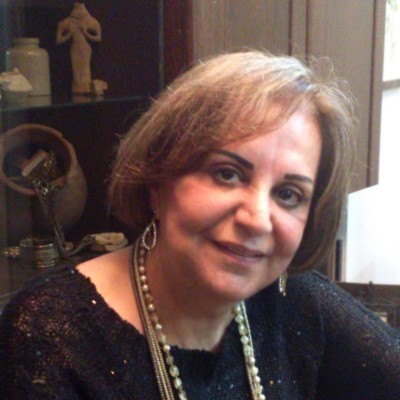
Maya Alrahabi (born Rome, Italy, 1954) is a Syrian-French physician, writer, researcher, and feminist and political activist. She is regarded as a leading figure in the contemporary Syrian feminist movement, known for her work on women’s rights, gender equality and the fight against gender-based violence, as well as for her involvement in Syrian civic and political life since the 1970s. She is the founder and director of Musawa — Centre for Women’s Studies.
She has taken part in numerous national, regional and international initiatives concerning women, peace and security.
Early life and education
Maya Alrahabi was born in Rome in 1954, where her father, Ahmad Alrahabi, served in the Syrian diplomatic corps. Her childhood was spent moving between several Arab countries before the family settled in Damascus. Shaped by the cultural and political environment she grew up in, she developed an interest in public affairs early in her school years.
She studied medicine at the University of Damascus, graduating in 1977, and went on to specialise in internal medicine in France and Germany. Throughout her studies and specialisation she continued her political and civic activity in opposition to authoritarian rule in Syria.
Medical and academic work
Alrahabi returned to Syria in 1987 and practised internal medicine at her own clinic. She later joined the teaching staff of the Syrian European University and took charge of the university clinic.
Alongside her medical practice, she sustained her cultural and research work, publishing in medicine, literature and feminist studies, and taking part in intellectual and cultural events both inside Syria and abroad.
Civic and political activity
With the beginning of the “Damascus Spring” in 2000, she joined the Committees for the Revival of Civil Society in Syria and took part in several initiatives promoting civic participation and democratic reform. She was among the founders of the Social Democrats movement, which called for peaceful democratic change, and contributed to the drafting of the National Accord document in 2009.
Following the outbreak of the Syrian revolution in 2011, she took part in the civic and political movement calling for a democratic transition and helped found several political and civic initiatives. She participated in the United Nations-sponsored political process through the Civil Society Support Room, and subsequently in the Syrian Negotiation Commission.
She left Syria at the end of 2014 after years of harassment and a travel ban, settling in France in 2016, where she obtained French citizenship. She returned to Syria after the fall of the Syrian regime in December 2024 and helped re-license and revive Musawa — Centre for Women’s Studies and Empowerment in 2025.
Feminist activity
Maya Alrahabi is among the figures who shaped the development of the Syrian feminist movement in the opening decades of the twenty-first century. From the turn of the millennium she helped found a number of feminist initiatives and organisations that sought to connect women’s issues with citizenship, democracy and human rights.
She co-founded the Women’s Committee of the Committees for the Revival of Civil Society, and helped establish the Feminist Initiative and Together in Support of Women’s Causes. She has organised training programmes and workshops on gender, equality, the political and economic empowerment of women, and women, peace and security, alongside her work on transitional justice, the missing, and housing and property rights from a gender perspective.
In 2012 she founded Musawa — Centre for Women’s Studies, dedicated to producing feminist knowledge, conducting studies and research, and running training programmes and empowerment projects for Syrian women inside Syria and abroad. That same year she founded Al-Rahba Publishing, which translates major works of international feminist thought into Arabic and publishes Arab scholarship on women’s issues.
Contribution to the history of Syrian feminism
Maya Alrahabi’s career marks one of the significant turning points in contemporary Syrian feminism. Her work coincided with a transitional period in which feminist discourse moved away from social and charitable activity towards a rights-based and political approach, connecting women’s issues to democracy, citizenship and social justice.
She worked to establish the concepts of gender, gender equality and the struggle against gender-based violence within Syrian civic circles, and trained generations of activists and researchers in advocacy, leadership and public work.
After 2011 she contributed to efforts to strengthen Syrian women’s participation in political life and in peacebuilding and negotiation processes, and to embed women’s issues within debates on Syria’s future and the rebuilding of its institutions.
Through her research and organisational work she has also helped build bridges between the Syrian feminist movement and Arab and international feminist movements, and has produced Arabic-language studies and reference works on feminism, gender, and gender-sensitive constitutions and legislation.
International work and gender expertise
Alrahabi has taken part in many regional and international projects on women’s rights and gender equality. Between 2018 and 2024 she prepared and edited materials and studies on gender-sensitive constitutions and legislation in cooperation with the EuroMed Feminist Initiative.
She has worked as an expert and consultant on projects combating violence against women, contributed to the preparation of the Common Agenda for Combating Violence Against Women in both Arabic and English, and served as a gender expert on specialised projects concerning transitional justice, the missing, and housing, land and property rights in the Syrian context, in cooperation with international organisations.
Since 2002 she has taken part in numerous international conferences and seminars on feminism, gender equality, human rights and democratic transition.
Published work
Medicine
- Diabetes (1987)
Literature
- A Liberated Woman on Display, short stories (1995)
- Furat, a novel (1998)
- Shawq (Longing), short stories (2000)
Television writing
- Awraq Khareefiya (Autumn Leaves), a trilogy
- Fus’ha Samawiya (A Heavenly Opening), television series (2005)
Feminist studies
- Islam and Women (2014)
- Feminism: Concepts and Issues (2014)
- Women and the Constitution
- What Are We Amending?
In addition to dozens of articles, papers and specialised studies on women’s issues and gender.
Intellectual significance
Maya Alrahabi represents the connection between feminist activism and civic and political work in Syria. Her intellectual and practical project has been distinguished by the effort to embed women’s issues within the paths of democratic reform and peacebuilding, and by her contribution to the development of contemporary Syrian feminist thought through research, training, organising and public work.